
Vermont/New England Project: The Pentagon: Exposing the Hidden Polluter of Water Potential Vermont Team members: Marguerite Adelman (WILPF and People for Peace and Security), Robin Lloyd (WILPF and People for Peace and Security), James Ehlers, Jennifer Decker (People for Peace and Security), Shaina Kaspar (Toxic Action), John Reuwer (PSR), Pat Elder (Military Poisons), Nancy Rice (Randolph Area Peace and Justice Coalition), and Cynthia Jackson, Randolph Area Peace and Justice Coalition) A New England tour on PFAS contamination of water would focus on the military and military sites since many groups don’t generally highlight the military contribution to this problem. Vermont is ahead in many areas, but there is still much we can do to further PFAS information, community knowledge, and advocacy in our state in the in the New England region. The Need/Problem: This WILPF US project is consistent with our Earth Democracy Committee’s commitment to the precautionary principle (i.e., "When an activity raises threats of harm to human health or the environment, precautionary measures should be taken even if some cause and effect relationships are not fully established scientifically."), guardianship of future generations, and the human right to water. The project focus is on the current epic drinking water crisis and the extent of the military’s contamination of water sources with PFASs and the subsequent impact on human health. Since the 1970s, the military’s widespread use of the specially-formulated aqueous film-forming foam (AFFF) for on-base fire-fighting training and for actual fires continues to contaminate the ecosystems on which all life depends: lakes, rivers, wildlife, and domestic animals as well as food both nationwide and abroad. Formulated with PFAS chemicals, AFFF is deemed “mission critical” by the Department of Defense (DoD) for fighting intensely hot, jet-fuel fires. The Environmental Working Group (EWG) reports that EPA tests have detected PFAS pollution in public water supplies for 10 million Americans in 33 states, but the EWG estimates, based on unreleased EPA test results, that the water supplies for as many as 110 million Americans may be contaminated and that communities have a right to know of their risk. Today, a record number of on-base military personnel and residents as well as those of surrounding communities who are suffering chronic and life-threatening illnesses are raising the alarm and demanding action. Yet, titles of recent articles in The New York Times, for example, tell the story of the federal Environmental Protection Agency (EPA) and DoD’s delay and inaction: “EPA Will Study Limits on Cancer-Linked Chemicals. Critics Say the Plan Delays Action” (Feb. 14); “Toxic ‘Forever Chemicals’ in Drinking Water Leave Military Families Reeling” (Feb. 22); “Pentagon Pushes for Weaker Standards on Chemicals in Drinking Water” (March 14); and “E.P.A. Proposes Weaker Standards on Chemicals Contaminating Drinking Water” (April 25). Articles on the health of military personnel and families living on base or in surrounding communities is reported in Civilian Exposure (www.civilanexposure.org) and Military Times (www.militarytimes.com/ ). EPA and DoD justify delay on the need for more study. Instead, accelerated action is desperately needed to protect our ecosystems and the public health from further harm. The EWG has called on Congress and federal regulators to act and proposes a list of actions in “Communities have a right to know,” March 28, 2019, that make clear what must be done. In the absence of federal action, at least 10 states are taking independent action to implement policies that establish maximum contaminant levels (MCLs) for PFASs below the EPA’s proposed 70ppt, fund cleanup of contaminated water, test for impact of water contamination with regular biomonitoring. Project Goal(s):
Vermont Geographic Focus: From EWG PFAS map military sites
Vermont Project Strategies: We will use the following effective and proven strategies to address the problem:
Measurable Outcomes for Vermont:
Project Plan--Timelines: The project will begin in December of 2020 and will continue through December of 2021. If we are advocating for a bill (indirectly, of course), we may need to time a lot of our work with legislative sessions. This may change timelines for this project and we’ll need to look at legislation and sessions in all 4 states. December of 2020 to April of 2021
May and June 2021
July to December of 2021
Grant Monies and Staffing: Grant monies can be used to pay Pat Elder for his work on a website and to be a speaker, as well as to pay others (Toxic Action) for roles that they might take in this project. We can use it for printing, advertising of programs, meetings, etc. It would be advisable to hire a grant coordinator for the four-state region…although this could be done by a volunteer. WILPF US will write grants, using the Peace Development Fund as our Fiscal Sponsor in order to support our work. A budget will be developed when we have plans developed for each state. What other groups should be involved:
Affordable PFAS Testing: $75 https://freshwaterfuture.org/community-resources/water-testing/ 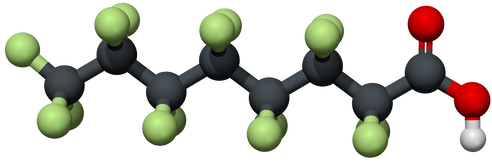 Perfluorooctanesulfonic Acid (PFOS) is one of more than 6,000 varietes of PFAS. Perfluorooctanesulfonic Acid (PFOS) is one of more than 6,000 varietes of PFAS.
We have learned the importance of testing during the coronavirus pandemic and the same lessons apply to PFAS.
PFAS are associated with many serious health conditions, such as immune system disruption, which can cause asthma, allergies, auto-immune diseases such as diabetes and lupus, and other health problems—underlying conditions that make people more vulnerable to viral infections and potentially more likely to suffer severe consequences if infected by the coronavirus. PFAS are something like Agent Orange, PCBs, and Asbestos all rolled into one. They can be toxic at extremely low levels, they don’t break down, and they bioaccumulate. The substances have become ubiquitous in the environment. They are present in millions of Americans’ tap water at unsafe levels and they are found in astonishingly high levels in the seafood we eat. PFAS are found in nearly all of our bodies. American babies are born pre-polluted with PFAS, which can pass from mothers to fetuses through the umbilical cord. For the most part, laboratory animals exposed to high doses of one or more of these 6,000+ PFAS chemicals have shown changes in liver, thyroid, and pancreatic function, as well as some changes in hormone levels. Because animals and humans process these chemicals differently, more research will help scientists fully understand how PFAS affect human health. (ASTDR). People exposed to high levels may have increased risk of kidney cancer or testicular cancer. Unfortunately, the EPA and federal authorities have failed us. They have failed to meaningfully regulate or control PFAS manufacture and use, failed to issue standards to protect our drinking water, ground and surface water, our food, air, and soil. It’s up to Vermont to protect Vermont. Let’s look at what the state has done thus far, before examining the role of the military. 
PFAS in Groundwater The Agency of Natural Resources has adopted two emergency rules to regulate these substances. The Investigation and Remediation of Contaminated Properties Rule is being amended to list these five PFAS as hazardous materials and the Groundwater Protection Rule and Strategy is being amended to adopt an enforcement standard of 20 parts per trillion for these substances. Like the standard for PFOA and PFOS, the 20 ppt enforcement standard applies to the sum of these substances (e.g. if PFOA = 3 ppt; PFOS = 10 ppt; and PFNA = 8 ppt then the sum of PFAS = 21 ppt and standard has been exceeded). 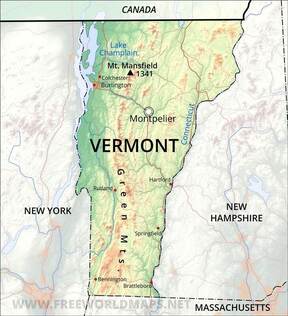
State of Vermont Plan Deriving Ambient Water Quality Standards for the Emerging Chemicals of Concern: Per- and Polyfluoroalkyl Substances (PFAS) Agency of Natural Resources, 2019
https://dec.vermont.gov/sites/dec/files/wsm/docs/VWQS-PFAS-Plan-Report-Final-20200204.pdf Abstract of the Executive Summary Act No. 21 of 2019 requires the Vermont Agency of Natural Resources (ANR) to develop a plan for the adoption of surface water quality standards for certain per- and polyfluoroalkyl substances (PFAS). The Secretary of Natural Resources shall publish a plan for public review and comment for adoption of surface water quality standards for per and polyfluoroalkyl substances (PFAS) that shall include, at a minimum, a proposal for standards for the five PDAS substances. On or before January 1, 2024, the Secretary of Natural Resources shall file a final rule with the Secretary of State to adopt surface water quality standards for these five chemicals. The Vermont Agency of Natural Resources makes the following recommendations: 1. Initiate State fish contaminant monitoring for PFAS to evaluate the impacts of PFAS on aquatic resources and provide data in support of a fish consumption advisory and future numeric standard. 2. Establish Human Health Criteria Using Fish Tissue Concentrations. The State has sufficient data to establish fish consumption advisories for Vermont-regulated PFAS. Fish consumption advisories have been used in the past with other contaminants of concern to limit exposure to known contaminants. 3. Establish programs to control PFAS sources to wastewater treatment plants. 4. Work with federal and state partners to develop aquatic biota criteria for PFAS. 
See the Environmental Working Group’s map and click on the reds and the purples.
https://www.ewg.org/interactive-maps/2019_pfas_contamination/map/ Go to Vermont and click on Burlington to find 72,000 ppt in Groundwater then click around the other sites in the state. Look at Maryland and realize they leave out ten additional bases that have been identified. https://www.civilianexposure.org/report-shows-15-military-bases-in-maryland-contaminated-with-pfas/ The EWG has still not thoroughly gone through the NAVFAC and the AF Environmental sites to identify contaminated soil GW, Surface water, septic sludge Here is the AF site: http://afcec.publicadmin-record.us.af.mil/ Here is the Navy site: https://www.navfac.navy.mil/products_and_services/ev/products_and_services/env_restoration/installation_map.html |
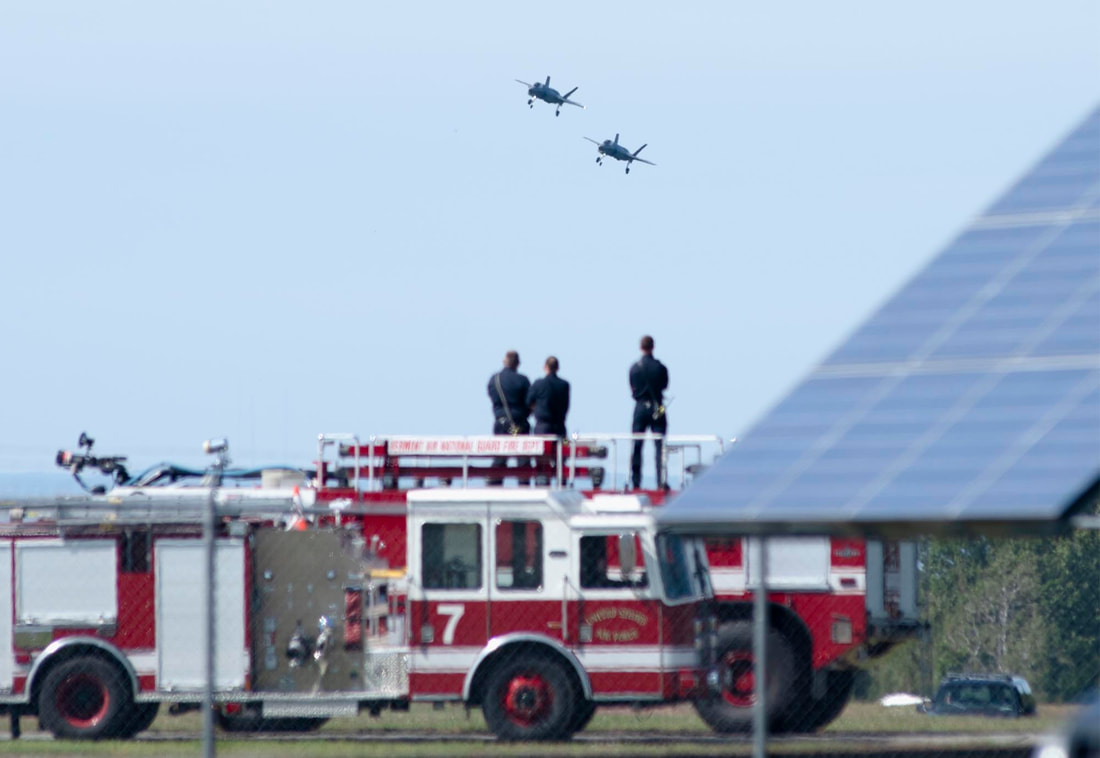
Firefighters greet the arrival of F-35's at the Burlington Air National Guard base.
Vermont leads the nation in responding to the threat posed by PFAS - but more needs to be done
Vermonters should feel good about how their state is responding to the presence of per- and poly fluoroalkyl substances (PFAS) in the environment. The actions of the Vermont General Assembly, the Vermont Department of Environmental Conservation and the Vermont Department of Health generally lead the nation, especially through the passage of stringent drinking water regulations. Hard core environmental activists are typically loathe to praise governmental entities for fear of stoking complacency - and that’s the case in Vermont where there’s still a ton of work to do to protect human health and the environment from the ravages of these “forever chemicals.” Although the state is ahead of both the learning and doing curves regarding these toxins, activists must focus on a few imperatives:

Vermont PFAS Drinking Water Data
See this comprehensive collection of Statewide PFAS Monitoring Results. The data is arranged in descending order with the most contaminated systems up top. Keep in mind that most states haven’t begun collecting this data. Generally, Vermont’s water systems are either drawing in relatively clean water or managing to install a variety of mechanisms like granular activated systems (GAC) to purify water. Vermont’s standard for the combination of five PFAS - PFOA, PFOS, PFHxS, PFHpA and PFNA is 20 parts per trillion, ppt. That means the sum of the five PFAS levels should not exceed 20 ppt in drinking water. Act 21, passed in 2019, requires approximately 650 Public Community and Non-Community water systems to test for PFAS. Initial testing was completed before December 1, 2019 and how often future testing happens will be determined based on the sample results. This testing is being coordinated by the Department of Environmental Conservation. Systems with PFAS above the 20 ppt standard will be required to post a Do Not Drink Notice to all users and pursue treatment or other permanent means to provide drinking water below the standard. Prior to installing any treatment, drilling or altering a well, or making any change to the water system that affects either the quality or quantity of water, a Construction and/or Source Permit will need to be obtained. 
Private wells in Vermont
At this point the state is only recommending that private well owners have their wells tested for PFAS, although in some instances, the testing should be mandatory at the state’s expense. For instance, we know there are astronomical levels of various types of PFAS at the Vermont Air National Guard base in Burlington that have contaminated groundwater. We also know these plumes travel to the North and Northeast so it would be prudent for the state to test privates several miles from the base in this direction. 
Private Well Owners - July, 2019
The Health Department recommends that all private well owners test their drinking water for naturally occurring contaminants, including bacteria, arsenic, and other elements. The public can order the recommended testing kits A, C and RA from the Health Department laboratory by calling 1-800-660-9997 or 802-338-4724. People can also order test kits from other certified drinking water laboratories. Use this link to find out more about the areas of concern in Vermont for PFAS contamination, and call DEC to determine if your well is in an area of concern at 802-828-1138. https://anrweb.vt.gov/PubDocs/DEC/PFOA/2019%20Statewide%20Sampling%20Plan/6.6.2019%20pfas%20plan.pdf To find certified laboratories that test for naturally occurring contaminants as well as PFAS, use this map: https://ahsvt.maps.arcgis.com/apps/webappviewer/index.html?id=1814e5a1da074c69bf496caf4e24855d For more questions about the health effects of PFAS, call the Health Department at 1-800-439-8550 or visit www.healthvermont.gov/water/pfas Vermont Suit Against Chemical Manufacturers
Leaves out the DOD 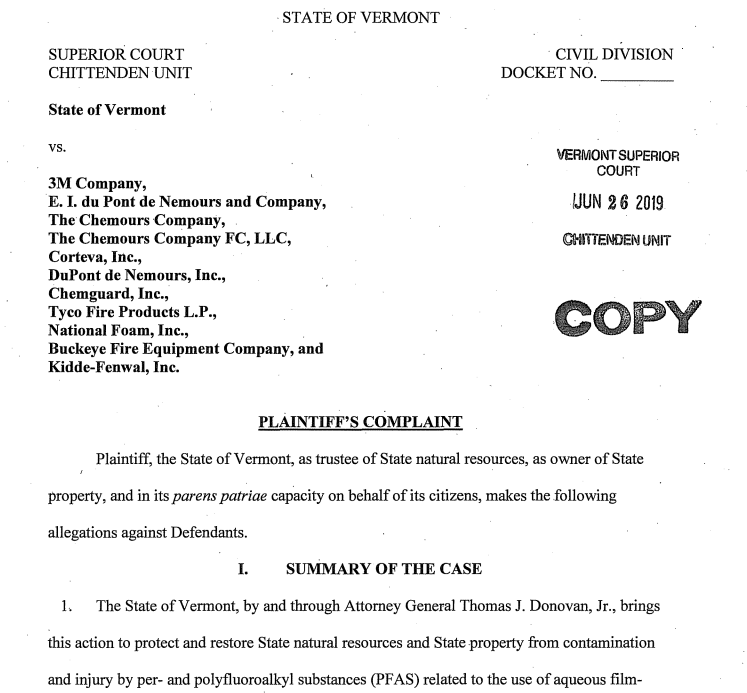
Vermont is suing DuPont, 3M, and other chemical companies for chemical contamination. "Despite knowing for decades that these chemicals were dangerous and harmful, the companies never told us," said Vermont Attorney General T.J. Donovan.
See the complaint here. Researching PFAS Contamination
Caused by the Military in Vermont (Burlington ANG Base) 
Step by step instructions Click on the AF site http://afcec.publicadmin-record.us.af.mil/ Select ANG up top Click on Burlington Under full document search, enter PFAS Click search Click on: Final Expanded Site Inspection Work Plan for PFAS (Part 1 of 5) (Transmittal Letter Attached) Search for: “analytical results” go to result 3 of 16 to find a map labeled: Figure 2.2 AOC 1 - Former FTA 1 (area of concern; Fire training Area 1) Look for the highest reading of PFOS/PFOA. 72 ug/l That’s 72,000 ppt. (Vermont's limit is 20 ppt in groundwater, so the Burlington ANG is 3,600 times over Vermont's limit. Also, the military is only providing analytical results for two types of PFAS - (PFOS & PFOA). Search for "Surface Water" and go to result 5 of 80: It gives you VT’s guidance. For instance, VT says 20 ng/l for GW. That’s 20 ppt. The base has PFOS/PFOA up to 72,000 ppt in one spot. Again, the ANG is only giving us values for PFOS/PFOA. Read this and see what folks near George AFB have in their water. https://www.militarypoisons.org/george-pfas.html There are 6,000+ varieties of PFAS and the world only seems to be talking about two, Search for groundwater flow: You’ll quickly find it is to the N or NW toward the Winooski. From Google maps, houses appear to have municipal water and that is fortunate, although the plume may have traveled north and west far beyond the town by now and much of the poison has been carried down the Winooski. Search for: Surface water drainage: Surface water drainage at Burlington ANG Base occurs through numerous streams along the western and northern boundaries of the Burlington airport with predominant drainage northward to the Winooski River. Muddy Brook flows along the eastern airport north boundary toward the Winooski River Search for sewer: Sewer outfalls are NE of the runway. Search for treatment: “Until recently, shallow groundwater intercepted by the groundwater collection trench was pumped to the Base sewer lift station and ultimately to the Airport Parkway Wastewater Treatment Plant (WWTP) in South Burlington, Vermont (CH2M HILL, 2015). Unvalidated analytical results for a water sample collected by USEPA from the groundwater collection trench sump on May 18, 2016, showed PFOS and PFOA concentration of 38 ug/l and 9.3 ug//l. (38,000 ppt and 9,3000 ppt)” Concerned citizens must discover where the sludge is applied to farm fields. The crops grown from those fields may be unsuitable for human or animal consumption. Search for: Incinerartion: “IDW (investigation derived waste) will be characterized and managed accordingly. IDW that is impacted with PFAS will be disposed of through high-temperature incineration while unimpacted soils will be disposed of onsite or at local landfills.” https://theintercept.com/2019/01/27/toxic-firefighting-foam-pfas-pfoa/ Search for Transport to pick up clues on the company that ships PFAS to offsite locations. Who is Parsons, Inc.? https://www.parsons.com/ What role do they play in shipping PFAS and/or guaranteeing your health? So, the ANG has contaminated your soil, groundwater, surface water, your river, your lake, your farms, and your air with chemicals that don’t go away and may be around for a thousand years to harm your progeny. You must test the farm soils. Test the produce. Test the private wells. Warn women who may be pregnant not to drink water with PFAS. Test the municipal wells. Test the river water. Test Lake Champlain. Test the seafood. The number way people who ingest the stuff is through eating seafood. PFAS is bioaccumulative and sea life soaks it up. See this piece on how this works: https://www.militarypoisons.org/webster-field.html 
PFAS in Drinking Water
at Vermont Army Air National Guard Bases Army National Guard - North Hyde Park Training Site, Vt. 5.96 2017 PFBA, PFHxA, PFOA, PFTeA Army National Guard - Westminster Training Site, Vt. 5.55 2017 PFBA, PFHxA, PFOA, PFTeA Army National Guard - Camp Ethan Allen, Vt. 112.20 2017 PFBA, PFHpA, PFHxA, PFOA, PFPeA https://cdn3.ewg.org/sites/default/files/u352/EWG_PFASTable-Army_C01.pdf?_ga=2.27118269.1802277307.1589039917-836179027.1562707229 Bombs in Your Backyard is an excellent Resource
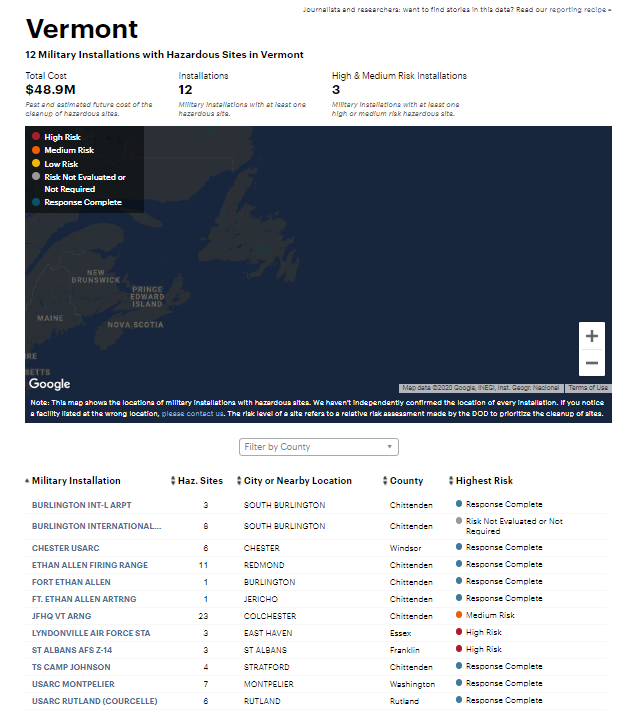
Burlington International Airport - Ground water contaminants
Arsenic 57.2 ug/L Vinyl Chloride 110.0 ug/L Toluene 210.0 ug/L 1,1- Dichloroethane 220.0 ug/L 1,2,4-Trimethylbenzene 270.0 ug/L Ethyl benzene 290.0 ug/L 1,1,1-Trichloroethane 310.0 ug/L Benzene 320.0 ug/L o-Xylene 740.0 ug/L Acetone 950.0 ug/L 1,2-Dichloroethylene (cis) 2800.0 ug/L 1,2-Dichloroethylene (Total) 3100.0 ug/L Manganese and compounds 4390.0 ug/L Iron 11500.0 ug/L Lyndonville Air Force Station Groundwater Contamination Benzene 4300000.0 ug/L Toluene 11438000.0 ug/L n-Hexane 19066000.0 ug/L Methylcyclohexane 19522000.0 ug/L Soil: Migration into groundwater. Contaminants: Acetone 0.018 mg/kg Methylene chloride 0.03 mg/kg Indeno[1,2,3-cd]pyrene 0.89 mg/kg Benzo[a]pyrene 2.0 mg/kg Carbazole 2.1 mg/kg Benzo[b]fluoranthene 2.5 mg/kg Chrysene 2.6 mg/kg Benz[a]anthracene 2.8 mg/kg Fluoranthene 4.2 mg/kg Pyrene 5.4 mg/kg ST ALBANS AFS Z-14 Groundwater Contaminants: 1,1-Dichloroethylene 1.0 ug/L Tetrachloroethylene (PCE) 1.6 ug/L Trichloroethylene (TCE) 6.4 ug/L 1,1-Dichloroethane 6.5 ug/L 1,2-Dichloroethylene (cis) 7.6 ug/L 1,2-Dichloroethane (EDC) 7.9 ug/L 1,1,1-Trichloroethane 8.1 ug/L Soil Contaminants: Tetrachloroethylene (PCE) 0.0014 mg/kg Trichloroethylene (TCE) 0.0055 mg/kg 1,2-Dichloroethane (EDC) 0.0068 mg/kg 1,1,1-Trichloroethane 0.0113 mg/kg Dibenz[ah]anthracene 0.43 mg/kg Indeno[1,2,3-cd]pyrene 1.7 mg/kg Benzo[a]pyrene 8.0 mg/kg Benzo[b]fluoranthene 8.3 mg/kg Benz[a]anthracene 13.0 mg/kg Vermonter John Reuwer asks, "How much of the PFAS contamination out there is due to military firefighting compared to all the civilian uses of the stuff?"
This is an excellent question and it is difficult to answer precisely with the lack of data we have available to us - especially the lack of analytical results from the DOD. Thankfully, California provided us with a glimpse into the respective shares of contamination in 2019 when it tested municipal 568 wells throughout the state. https://www.militarypoisons.org/pleasanton.html Of the 568 wells tested by the California State Water Resources Board for PFAS chemicals in 2019, 308 (54.2%) were found to contain one, or a variety of different PFAS. The Water Board tested civilian airports, municipal solid waste landfills, and drinking water sources within a 1-mile radius of wells already known to contain PFAS. With a few exceptions like Pleasanton, the testing stayed away from communities close to military installations. A total of 19,228 parts per trillion (ppt) of the 14 kinds of PFAS tested were found in those 308 wells. 51% were either PFOS or PFOA while the remaining 49% were other varieties of PFAS. Meanwhile, five military bases in the state: China Lake Naval Air Station, Port Hueneme, Mather Air Force Base, Tustin USMC Air Station, and Travis Air Force Base have contaminated groundwater with 11,472,000 ppt, of PFOS + PFOA. If the roughly 50-50 split between PFOS/PFOA and other PFAS contaminants found in 308 wells tested throughout the state is any indication, these five installations may be responsible for PFAS contamination at levels above 20,000,000 ppt. More than 50 military bases are known to have used PFAS in California. The military has likely discharged hundreds of thousands of gallons of fire-fighting foam containing these deadly carcinogens into California’s groundwater and surface water. This paints the picture a little bit more so, although it doesn’t specifically address military contamination vis-à-vis commercial contamination. . https://worldbeyondwar.org/the-pfas-contamination-crisis-us-military-poisons-hundreds-of-communities/ |
- Home
- Okinawa
- Wallace - Elder
- Antietam Creek
- Maryland
- Crabs
- Burlington ANG Part 1
- Burlington ANG Part 2
- Burlington ANG Part 3
- So MD News
- MetCom Reports
- Contact
- Maryland Military Bases
- Vermont
- Patuxent River Series
- Tour and Forum Info
- Alameda
- Almaden
- Angel Island
- Arcata
- Azusa
- Baltsun
- Barstow Marine Corps Base
- Beale AFB
- Beale Flyer
- Benicia
- Blythe
- Bodega
- Bolsa Chica
- Borrego Springs
- Bridgeport USMC
- CA PFAS
- CA PFAS Bill
- Camp Callan
- Camp Coxcomb
- Camp Elliott
- Camp Essex
- Camp Haan
- Camp Iron Mountain
- Camp Lockett
- Camp Matthews
- Camp Parks
- Camp Pendleton
- Camp Roberts
- Castle AFB
- Caveat Emptor
- Channel Islands ANG
- Ches Beach
- Chico
- China Lake
- Coast Guard
- Cohoes Data
- Cohoes Sources
- Concord
- Contaminated Oysters & Water in MD
- Coronado
- Costa Mesa ANG
- Covid-19 on Navy Ships
- Crow's Landing
- Daggett
- Databases
- Detachment Fallbrook
- Dixon Naval Radio Transmitter Facility
- Do not eat the fish
- D-Q Univ.
- Edwards
- El Centro
- El Toro
- Fallbrook
- Food & Water
- Fort Barry
- Fort Hunter Liggett
- Fort Irwin
- Fort Ord
- Forum Program
- Fresno
- FUDS
- Fresno ANG
- Futenma Foam
- George AFB
- George PFAS
- Hamilton
- Hawaii
- Holtville
- Hunter's Point
- Imperial Beach
- Inyokern
- JB Andrews Contaminates Maryland
- Joint Base Andrews
- Lake Chabot
- Lawrence Livermore
- Lemoore NAS
- Links
- Long Beach
- Los Alamitos
- Los Angeles AFB
- Maine
- March AFB
- Mare Island
- Maryland PFAS Bill
- Massachusetts
- Mather AFB
- McClellan AFB
- MD Report Deceives Public
- MD Seafood is Contaminated
- MD slow on PFAS
- MD to Test Water Oysters,
- Mike Miller
- Mike Pence
- Miramar
- Moffett Field
- Mojave Gunnery Range
- Mount Owen Rifle Range
- NASA JPL
- NATO Poisons Fish
- Needles
- New Hampshire
- North Highlands ANG
- North Island NAS
- Norton AFB
- Oakland Army Base
- Oakland FISC
- Onizuka AFB
- Ontario ANG
- Okinawa
- Okinawan Frustration
- Oxnard AFB
- Palmdale AF Plant #42
- PFAS Action Act
- PFAS in Fish
- PFAS Task Force
- Parks
- Pat Elder Bio
- Pax River 1 - What we don't know
- Pax River 2 - Other Chemicals
- Pax River 3 - St. Inigoes Creek
- Pax River 4 - Q's to Ask
- Pax River 5 - Naval Confusion
- Pax River 6 - Response to Enterprise
- Pax River 7 - Leg. Remedies
- Petaluma
- Petition
- PFAS & Nuclear Weapons
- Pleasanton
- Point Loma
- Point Molate
- Point Mugu
- Port Hueneme
- RABs
- Redding
- Researching PFAS Contamination
- Rice Valley
- Riverbank
- Sacramento Army Depot
- Salton Sea Test Range
- San Clemente
- San Diego
- San Diego Space
- San Louis Obispo
- San Nicolas Island
- Santa Rosa
- Seal Beach
- Sepulveda Air Guard Station
- Sharpe Army Depot
- Sierra Army Depot
- Siskiyou
- Stanislaus
- Stockton Naval
- Sue the Military
- Sunnyvale
- Teddy Roosevelt
- Test the waters in MD!
- Testing
- Tracy Defense Depot
- Travis AFB
- Treasure Island
- Tustin USMC Air Station
- Twentynine Palms
- UC Davis
- Vandenberg AFB
- Warning letter from Navy
- Water Board
- Webster Field
- What's in your water?
- Where are the results?
- WSSC
- Dog & Pony Show
- Pax River AFFF Use
- Test Results - St. Mary's
- Satire
- Burlington 2018 Report
- Westminster, MD & PFAS
- Oklahoma
- Poisoning Memphremagog and the Winooski
- Untitled
- Creech AFB is poisoned
- Lake Memphremagog
- Military Poisons will have a new website
- New Military Poisons Website
- Big Lie in Vermont
- Webster Field Contaminates St. Mary's
- Andrews 2015 Report
